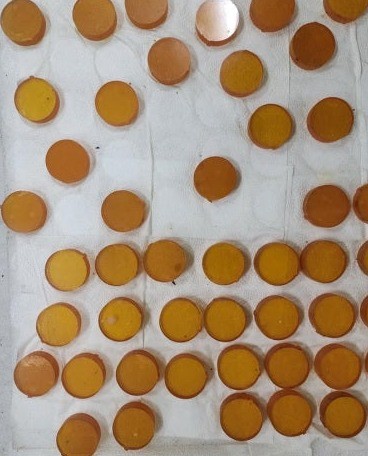
Knoop 105–120. Selenium chemistry. Gloves, wet grind, SDS on the bench before the first blank hits a spindle. This is not BK7.
Soft
Harris, Materials for Infrared Windows and Domes (SPIE, 1999), puts CVD ZnSe with the soft IR crystals. KM datasheet Knoop is 110 kg/mm²; published range 105–120 (50 g indenter); ADA042147 listed 100. KM Young’s modulus is 71 GPa and Poisson 0.32; Harris quotes 67.2 GPa and 0.28. KM flexural strength is 54 MPa. A fingerprint on an uncoated face is a generating tool. Steel tweezers leave a record. Dry paper scratches. We spec edge chip on cores at < 0.762 mm (0.030") because the water jet and the core drill leave chips. That is incoming inspection, not a speech.
The thermal ceiling is the other handling limit people skip: ZnSe oxidizes significantly at 300 °C, plastically deforms around 500 °C, and dissociates around 700 °C. Published notes recommend not using windows above 250 °C in air. A CO2 head that cooks a dirty AR is a selenium fume problem, not only a focus problem.
Toxic
The finished window is not hydrogen selenide. Dust, slurry and fire products still carry selenium. NIOSH REL for selenium and most Se compounds is 0.2 mg/m³ TWA as Se; IDLH 1 mg/m³ as Se (NIOSH IDLH documentation, May 1994, CAS 7782-49-2). OSHA PEL is the same 0.2 mg/m³ (29 CFR 1910.1000 Table Z-1). Dry grinding puts that dust in the room. Wet process, local exhaust, gloves, no compressed-air blow-off of slurry. The hydride gas (H2Se, CAS 7783-07-5) is a plant problem — REL/PEL 0.05 ppm, IDLH 1 ppm, odor of decayed horseradish, relative density 2.80 — and it does not travel in the crate. I wrote that out in the selenium note.
Current file: KM Innovation Zinc Selenide SDS (PDF). Ship-to country is required so the hazmat paperwork matches the crate. Spent windows and broken blanks can come back to Florida for disposal — sales@kminnovationusa.com.
References. Harris, D.C., Materials for Infrared Windows and Domes, SPIE (1999). NIOSH Pocket Guide, selenium (CAS 7782-49-2) and hydrogen selenide (CAS 7783-07-5). NIOSH IDLH, May 1994. OSHA 29 CFR 1910.1000 Table Z-1. KM Innovation SDS.