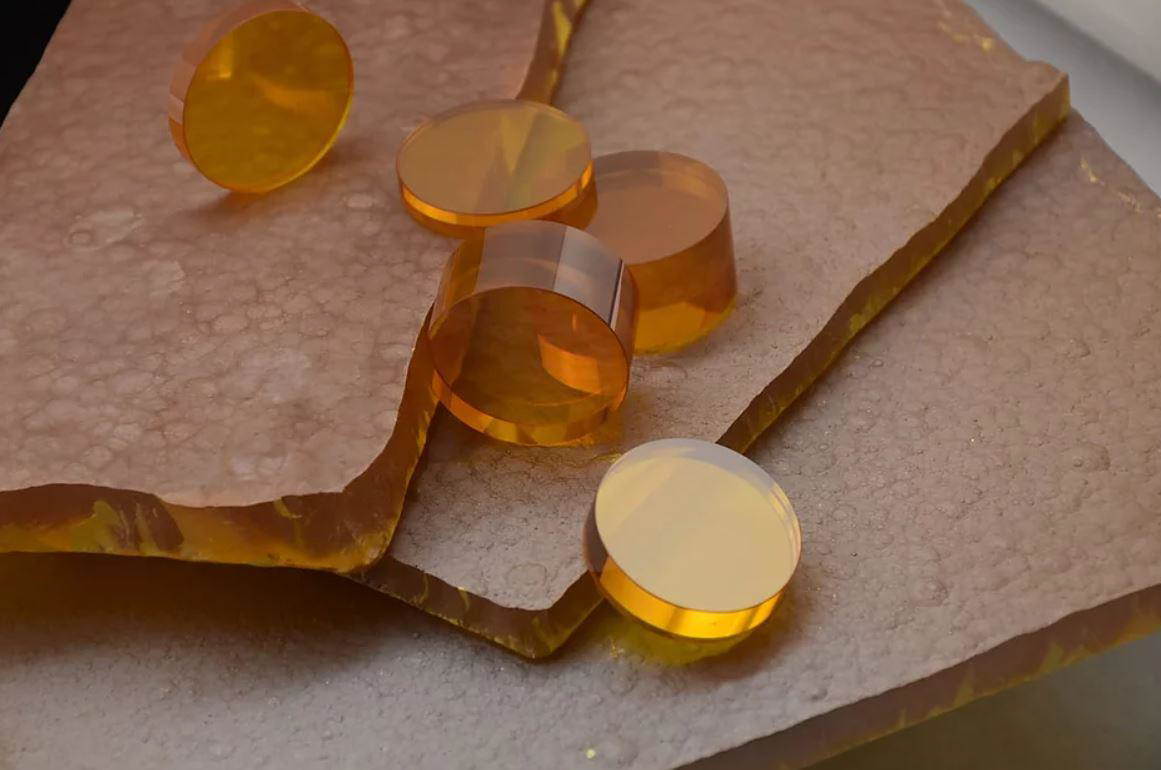
Zinc selenide is ZnSe, one zinc to one selenium. We grow it as a polycrystalline plate by CVD in South Korea. The amber color is the band edge, not a dye. Most of the fights on a drawing come back to that lattice and that index.
The structure is cubic zincblende (sphalerite), space group F–43m. Each zinc is tetrahedrally bound to four selenium, and the reverse. Lattice constant is 5.667 Å. Formula weight 144.35 g/mol. Density at room temperature is 5.27 g/cm³. Those three numbers sit in Palik’s Handbook of Optical Constants of Solids, in Harris’s Materials for Infrared Windows and Domes (SPIE, 1999), and on the KM datasheet we send with the quote. Incoming inspection should weigh the blank against CAD volume × 5.27. If the mass is off by more than a few percent, the blank is wrong, not the periodic table.
Why a CO2 window is yellow
Room-temperature band gap is about 2.70 eV (handbooks put 2.67–2.70 eV at 25 °C; ~2.82 eV at 10 K). Blue and near-UV are absorbed. What remains of the visible is yellow-amber. That is why the same optic can carry a 633 nm HeNe alignment beam and a 10.6 µm resonator. Germanium cannot. Silicon cannot. That visible-plus-IR window is why ZnSe still sits in high-power CO2 beam trains. Useful bulk transmission is quoted 0.6–21 µm in the handbooks; coatings and the reststrahlen near 45.7 µm cut the long end. On our quote we treat 0.6–16 µm as the working band for uncoated plate.
The crystal is soft. KM datasheet Knoop is 110 kg/mm². Published range is 105–120 (50 g indenter); ADA042147 listed 100. KM Young’s modulus is 71 GPa and Poisson 0.32; Harris (SPIE, 1999) quotes 67.2 GPa and 0.28. KM flexural strength is 54 MPa. A fingerprint on an uncoated face is a generating tool. Steel tweezers leave a record. Gloves.
Index at 10.6 µm — who actually measured it
D. T. F. Marple at GE Schenectady measured ZnSe, ZnTe and CdTe by prism refraction in 1964 (J. Appl. Phys. 35, 539–542). His Sellmeier for ZnSe — n² = 4.00 + 1.90 λ²/(λ² − 0.113) — covers 0.48–2.5 µm. It is the near-IR pedigree, not the 10.6 µm column. H. H. Li at Purdue CINDAS compiled ZnS, ZnSe and ZnTe in J. Phys. Chem. Ref. Data 13, 103–150 (1984) and recommended ZnSe from 0.55–18 µm between 93 and 618 K, with dn/dT from the same fit.
The CVD number everyone copies is Connolly, diBenedetto and Donadio, Proc. SPIE 181, 141–144 (1979), later fitted by Tatian, Appl. Opt. 23, 4477–4485 (1984). NBS minimum-deviation work on two CVD prisms (Feldman et al., NBS optical-materials characterization) gave n = 2.40278 at 10.6 µm near 21 °C. Connolly/Tatian and NBS list 2.4028. The KM datasheet we issue lists n = 2.403 at 10.6 µm. For a coating design those are the same number. For incoming inspection we use the KM sheet against the lot.
One uncoated face: R = ((n−1)/(n+1))² = 17.0% at n = 2.403. Two faces, ignoring etalon structure in a thick plate, transmit (1−R)² ≈ 0.689 — about 31% is lost at the surfaces. Some published tables quote 29.1% two-surface loss; the difference is n and whether a little bulk absorption is folded in. That is Fresnel, not a coating brochure. Arithmetic in the Fresnel note.
Absorption, grain, heat
Bulk absorption at 10.6 µm is the number that decides whether a focusing lens lives. KM datasheet: < 5×10⁻⁴ cm−1. Published CVD ZnSe tables sit near 5.0×10⁻⁴ cm−1 at 10.6 µm. DTIC ADA042147 already listed 4×10⁻⁴ cm−1 on laser-quality CVD in 1977. Grain: KM < 100 µm; ADA042147 table ~70 µm. Thermal conductivity at 298 K: KM 20 W m−1 K−1; published tables often 18. dn/dT at 10.6 µm is +61×10−6 K−1 (published, 298–358 K). That combination — low absorption, modest conductivity, large thermo-optic coefficient — is why a dirty or absorbing lens walks focus before it cracks.
Published notes also flag the thermal ceiling people forget: ZnSe oxidizes significantly at 300 °C, plastically deforms around 500 °C, and dissociates around 700 °C. Published notes recommend not using windows above 250 °C in air. Melting point is quoted 1525 °C; you will never see it in a CO2 head.
What we put on a KM quote
| Property | KM datasheet / plant | Literature / industry |
|---|---|---|
| Transmission band | 0.6–16 µm useful | 0.6–21 µm in handbooks (bulk; coatings cut the ends) |
| n @ 10.6 µm | 2.403 | 2.4028 (Connolly / NBS) |
| Bulk absorption @ 10.6 µm | < 5×10⁻⁴ cm−1 | published tables ~5×10⁻⁴; ADA042147 4×10⁻⁴ (1977) |
| Grain | < 100 µm | ADA042147 ~70 µm |
| Max size | Dia 800 × 30 mm T | Plant envelope, not a catalogue SKU |
| k @ 298 K | 20 W m−1 K−1 | ~18 W m−1 K−1 (published tables) |
| dn/dT @ 10.6 µm | — | +61×10−6 K−1 (published, 298–358 K) |
| Knoop | 110 | 105–120 (published; 50 g indenter) |
| Young / Poisson | 71 GPa / 0.32 | 67.2 GPa / 0.28 (Harris) |
| Flexural strength | 54 MPa | — |
We sell polycrystalline CVD plates, windows, SMTY and blanks. Bridgman or CVT single-crystal ZnSe for substrate or quantum-well work is a different chemistry and a different RFQ. Fujiwara’s iodine-CVT crystals grew at ~0.1 mm/day (J. Crystal Growth 196, 83, 1999). That is not this plant.
References. Marple, D.T.F., J. Appl. Phys. 35, 539–542 (1964). Li, H.H., J. Phys. Chem. Ref. Data 13, 103–150 (1984). Connolly, J., diBenedetto, B., Donadio, R., Proc. SPIE 181, 141–144 (1979). Tatian, B., Appl. Opt. 23, 4477–4485 (1984). Feldman, A. et al., NBS optical-materials characterization of CVD ZnSe (n = 2.40278 at 10.6 µm). Harris, D.C., Materials for Infrared Windows and Domes, SPIE (1999). Palik, E.D., Handbook of Optical Constants of Solids. Miles, P. et al., DTIC ADA042147 (1977). KM Innovation ZnSe datasheet (issued with the quote).