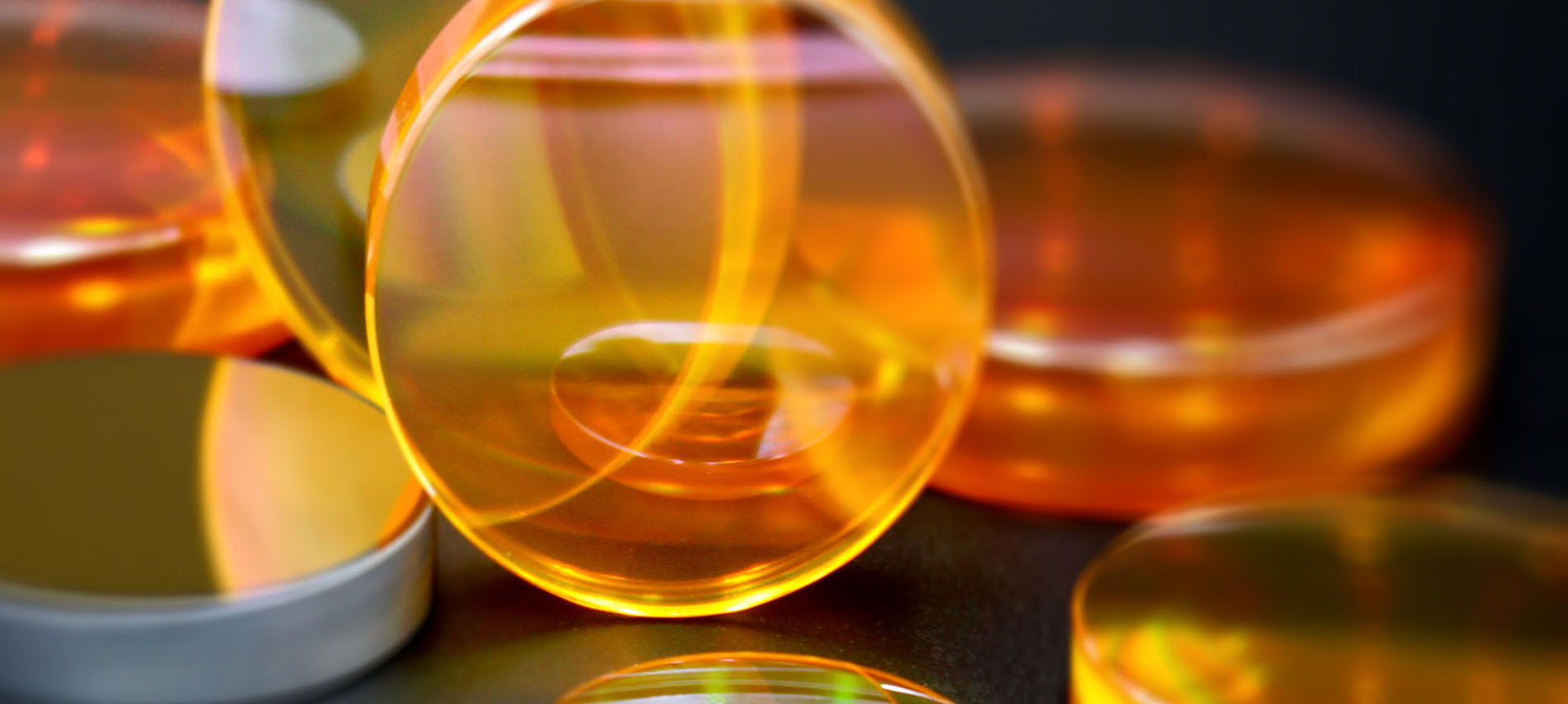
Same CVD chemistry. Two ways the part is specified. Size alone is not a specification — a resonator and a camera window are not the same buy. Density is 5.27 g/cm³ either way. Absorption is not. Lot values are on the quotation.
Numbers below are from the KM datasheet, DTIC ADA042147, and published CVD-ZnSe literature. They are not KM furnace internals.
Laser grade — the 10.6 µm number
The specification that matters on a CO2 focusing lens is bulk absorption at 10.6 µm. KM datasheet: < 5×10⁻⁴ cm−1. Published CVD ZnSe tables sit near 5.0×10⁻⁴ cm−1 at 10.6 µm. DTIC ADA042147 already listed 4×10⁻⁴ cm−1 on laser-quality CVD in 1977. Coarser mill grades around 1×10⁻³ cm−1 are not cutting-head material.
That class of loss, with KM k = 20 W m−1 K−1 at 298 K (published tables often 18) and dn/dT ≈ +61×10−6 K−1 (published 6.1×10⁻⁵ K−1 at 10.6 µm, 298–358 K), is what keeps a kW-class lens from walking focus and cooking the AR. A 5 mm path at 5×10⁻⁴ cm−1 absorbs about 0.025% of the beam in the bulk. That sounds small until the coating is dirty and the residual is dumped into a crystal whose thermo-optic coefficient is six times that of BK7. We quote laser grade when the print says CO2, resonator, cutting head, or 10.6 µm AR.
Index homogeneity is the other laser number people forget. KM datasheet refractive-index inhomogeneity is < 3 ppm at 632.8 nm. Grain on laser-quality CVD is typically tens of micrometres (ADA042147 ~70 µm; KM < 100 µm). Grain scatter at 10.6 µm is usually not the limiter; absorption is.
Optical grade — imaging, not resonators
Thermal cameras (8–12 µm), FTIR windows, viewports. Homogeneity and scatter in the visible-to-MWIR matter more than the last 10−4 at 10.6 µm. Published tables are honest about the short-wave end: 5.0×10⁻³ cm−1 at 1.3 µm, 7.0×10⁻⁴ at 2.7 µm. Optical grade is usually the right buy for a thermal-camera window. It is the wrong buy for a cutting-head lens. I have seen shops mix them on a BOM because the density and the color look the same on the dock. The laser finds the absorption. The camera finds the scatter and the wrong AR.
Specification
| If the optic… | Specify |
|---|---|
| Focuses or outcouples a CO2 beam | Laser grade + AR (10.6 or dual-band) |
| Looks at 8–12 µm scene radiance | Optical grade + LWIR AR |
| Is a raw blank you will grind and coat | Grade + SMTY / core / edged |
| Must pass a HeNe and a CO2 | Laser grade, dual-band AR, say so |
We stock and cut both. Coating does not change the grade — a perfect AR on optical-grade plate does not turn it into laser grade. The coating sits on the surface. Bulk absorption still cooks the optic from the inside. Grade and coating are two independent lines.
References. KM Innovation ZnSe datasheet (α < 0.0005 cm−1; inhomogeneity < 3 ppm at 632.8 nm; k = 20 W m−1 K−1). Miles et al., DTIC ADA042147 (1977). Harris, D.C., SPIE (1999).