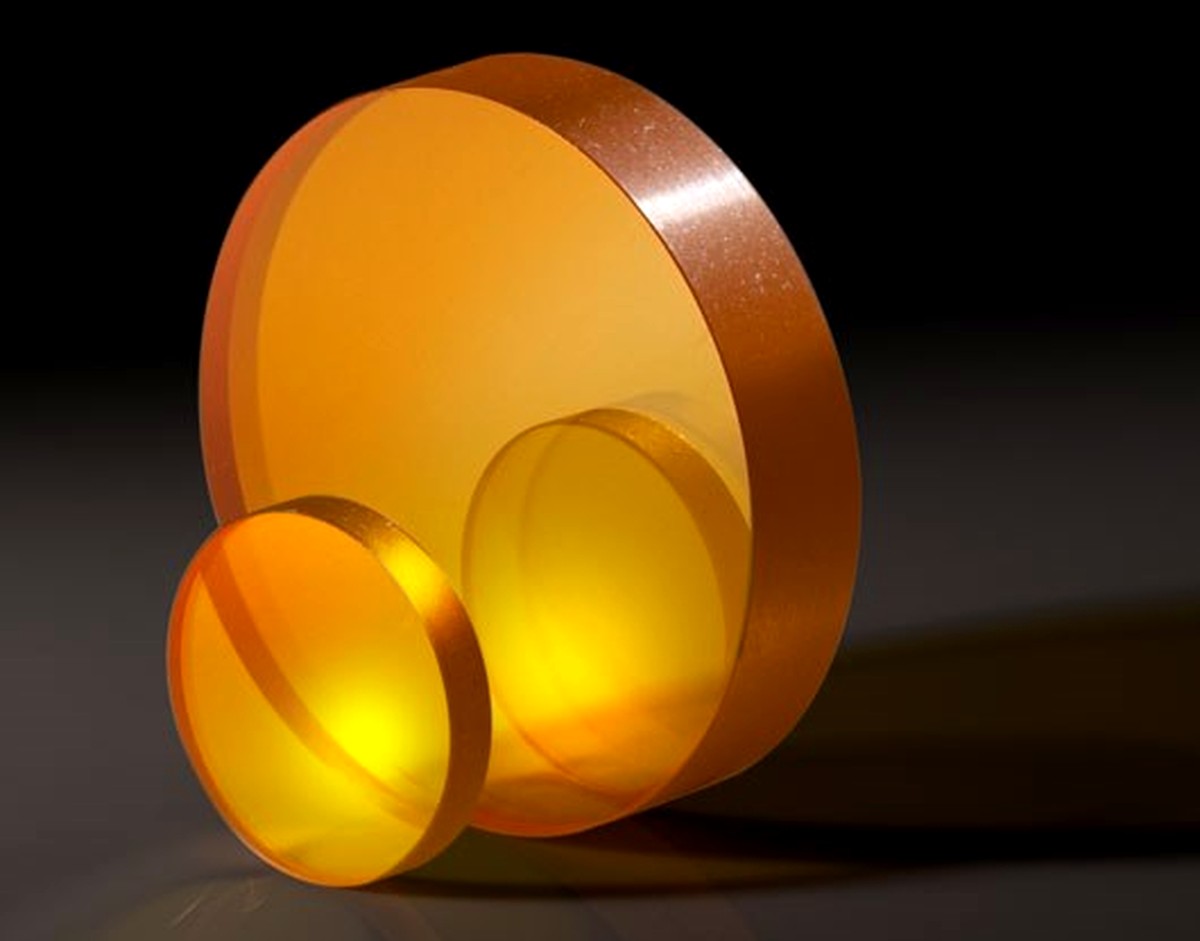
At 10.6 µm the KM datasheet gives n = 2.403. The Connolly/Tatian CVD table and NBS list 2.4028. Either way an uncoated window is two Fresnel surfaces, not a clear pane.
The arithmetic
Normal-incidence reflectance from one dielectric interface is R = ((n−1)/(n+1))². For n = 2.403 that is (1.403/3.403)² = 0.170, about 17.0% per face. Two faces in series, ignoring multiple-beam interference in a thick plate, transmit (1−R)² ≈ 0.689, so about 31% is thrown away at the surfaces. Published two-surface reflection loss at 10.6 µm is 29.1%. The small difference is the exact n and whether they fold in a little bulk absorption. For a resonator I treat uncoated ZnSe as “thirty percent gone before the bulk even sees the beam.”
The 10.6 µm index is not Marple’s 1964 Sellmeier. Marple’s prism work on ZnSe stopped at 2.5 µm (J. Appl. Phys. 35, 539). H. H. Li’s CINDAS compilation (J. Phys. Chem. Ref. Data 13, 103, 1984) covers 0.55–18 µm. The CVD column everyone copies is Connolly, diBenedetto and Donadio, Proc. SPIE 181, 141 (1979), fitted by Tatian, Appl. Opt. 23, 4477 (1984). NBS minimum-deviation on two CVD prisms gave n = 2.40278 at 10.6 µm near 21 °C. KM lists 2.403. For coating design those are the same number.
HeNe sees a higher index
At 0.633 µm the same Connolly table is n ≈ 2.59. One-face Fresnel is then about 19.5%. A dual-band AR is not a checkbox; it is a stack that gives back some 10.6 µm performance to keep a 633 nm alignment beam. A 10.6-only V-coat is usually the lowest residual at the laser line and a poor HeNe window. Say which failure you cannot live with.
Index also walks with temperature. Published dn/dT = 6.1×10⁻⁵ K−1 at 10.6 µm (298–358 K), and 1.7×10⁻⁴ K−1 at 0.6328 µm. A hot uncoated window is a slightly different optic than the one you aligned cold.
Uncoated vs AR
Uncoated is correct for some FTIR windows, ATR plates, and process viewports where you want the bulk spectrum, not a coating spectrum. It is the wrong default for a CO2 resonator or a cutting-head lens. Specify AR 10.6 µm both faces, or dual-band 10.6 µm + 633 nm, if a HeNe rides the same path. Do not assume a window arrives coated. Coating curves, residual reflection and laser-damage numbers are issued on the quotation against a part number. Laser grade is the absorption number at 10.6 µm; optical grade is for imaging. Coating does not change the grade.
References. Marple, D.T.F., J. Appl. Phys. 35, 539–542 (1964). Li, H.H., J. Phys. Chem. Ref. Data 13, 103–150 (1984). Connolly, J. et al., Proc. SPIE 181, 141–144 (1979). Tatian, B., Appl. Opt. 23, 4477–4485 (1984). Feldman et al., NBS CVD ZnSe (n = 2.40278 at 10.6 µm). KM Innovation ZnSe datasheet, n = 2.403 @ 10.6 µm.