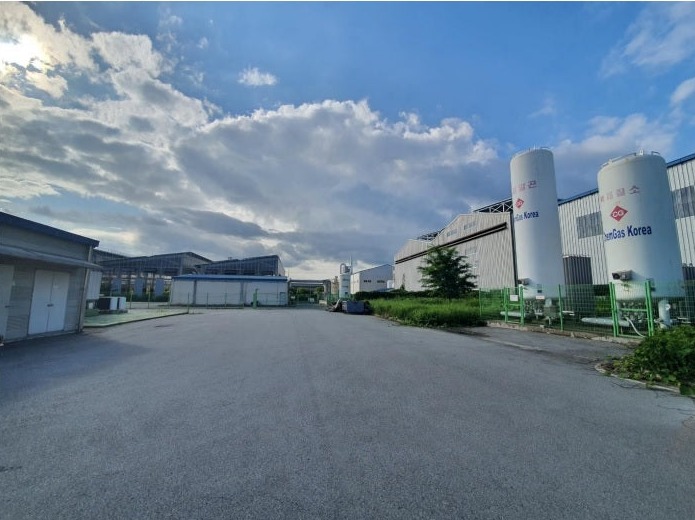
The infrared window of ZnSe comes from selenium on the anion site. The plant that grows it therefore has a hydride gas hall, not only a water jet. Florida quotes. The chemistry stays in South Korea.
KM’s CVD reaction is the one Miles et al. published in 1977 (DTIC ADA042147) and that still sits in every process patent:
Zn (g) + H2Se (g) → ZnSe (s) + H2 (g)
Hydrogen selenide, CAS 7783-07-5, is a colorless gas. NIOSH Pocket Guide: odor resembling decayed horseradish; molecular weight 81.0; boiling point −42 °F; vapor pressure 9.5 atm at 70 °F; relative gas density 2.80; conversion 1 ppm = 3.31 mg/m³. It is shipped as a liquefied compressed gas (DOT 2202). Because the vapor is heavier than air, a leak puddles. It does not float away.
The numbers that actually govern the hall
OSHA PEL and NIOSH REL are both 0.05 ppm TWA (0.2 mg/m³). NIOSH IDLH is 1 ppm (revised 1994). AIHA lists an odor threshold around 0.3 ppm; olfactory fatigue sets in quickly at that concentration, which is why “I can still smell it, so I’m fine” is not a monitor. Dudley and Miller’s guinea-pig work is still in the IDLH file: Public Health Reports 52, 1217 (1937) and the 1941 follow-up. NIOSH quotes them directly — 12.5% of guinea pigs died within 30 days after 2 h at 1.8 ppm; 4 h at 1.8 ppm killed 18.8%; 4 h at 2.1 ppm killed 25%. Human reports in the same papers: 1.5 ppm was intolerable from eye and nasal irritation. Friberg et al. (1979), cited by NIOSH, note that H2Se oxidizes to red selenium on mucous membranes, which is probably why documented human fatalities are scarce. That is chemistry, not comfort.
NRC AEGL documentation later discussed Zwart and Arts (1989) and argued the 1937–41 work may have overestimated acute lethality. The legal limits we work to in a US quote are still OSHA/NIOSH 0.05 ppm and IDLH 1 ppm. AIHA ERPG-2/ERPG-3 for H2Se are 0.2 ppm / 2 ppm. KM makes H2Se on site from Se 99.999% and H2 99.995% (company introduction, Rev. 2023.06). We do not put reactor pressures, generator rates or alarm setpoints on this page. The quote desk is Florida. The gas plant is not.
The solid on your dock
A finished window is not H2Se. It is still a selenium compound. NIOSH REL for selenium and most Se compounds (CAS 7782-49-2 as Se) is 0.2 mg/m³ TWA; IDLH 1 mg/m³ as Se (revised 1994, based on Olson 1986 and Pletnikova 1970). Dry grinding puts that dust in the room. Wet process, extraction, gloves. We send the KM Innovation Zinc Selenide SDS with the quote. Ship-to country is required so the hazmat paperwork matches the crate. Spent windows and broken blanks can come back to Florida for disposal — sales@kminnovationusa.com.
References. NIOSH Pocket Guide, hydrogen selenide (CAS 7783-07-5) and selenium (CAS 7782-49-2). NIOSH IDLH documentation, May 1994, 7783-07-5 and 7782-49-2. Dudley, H.C., Miller, J.W., “Toxicology of selenium. IV. Effects of exposure to hydrogen selenide,” Public Health Rep. 52, 1217–1231 (1937); and the 1941 follow-up cited by NIOSH. OSHA 29 CFR 1910.1000 Table Z-1. Friberg et al. (1979), cited in NIOSH IDLH. AIHA ERPG hydrogen selenide. Miles, P. et al., DTIC ADA042147 (1977). KM Innovation SDS and 2023.06 plant introduction.